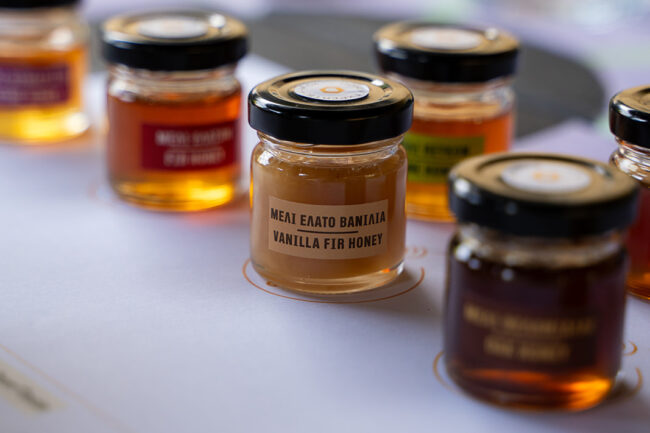
The discussion around honey adulteration is not new. However, in recent years the problem has escalated to a level that threatens both consumer trust and the reputation of Greek beekeeping. At Honey Experts—through tasting seminars, educational workshops, TV and radio appearances, and guided visits to beekeeping sites—we meet people every day who ask the same question: “What exactly is the honey I’m buying?” and “How can I identify adulteration?”
The Rise of Artificial Syrups from China
One of the most serious problems today is the massive import of artificial syrups, mainly from China. These syrups are engineered to look like honey—without being produced by bees. They are made from hydrolyzed sugars (rice, corn, beet), chemically modified to resemble natural honey, and most importantly, they contain no pollen.
The absence of pollen—nature’s “biological fingerprint” of every honey—allows those who use these syrups to conceal the true origin of the product.
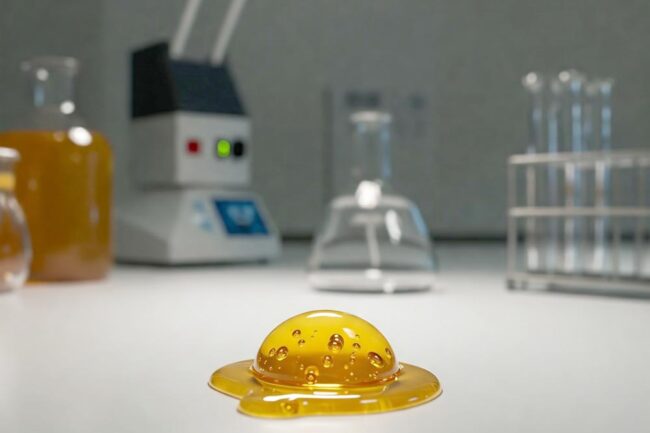
Quality control Lab, for honey analysis
Why Sensory Evaluation Alone Is Not Enough
During our tasting seminars at Honey Experts, participants are often surprised to learn that taste—although incredibly valuable—is no longer sufficient for detecting adulteration. Modern syrups have such a neutral and “clean” profile that in some cases they imitate honey far better than one would expect.
This is where science becomes essential.
Pollen analysis, aromatic profiling, electrical conductivity, moisture content, and isotopic methods reveal what the human palate cannot.
For this reason, in all our educational activities, we emphasize the connection between sensory training and scientific knowledge.
Legal Gaps That Encourage Fraud
Another significant issue is the regulatory framework. European legislation still allows vague labels such as “Blend of EU and non-EU honeys.” In other words, consumers have no way of knowing whether their honey comes from Greek nature or from a cheap mixture sourced from third countries.
This lack of transparency creates fertile ground for mislabeling, “Greek-styled” products, and misleading packaging that exploits the strong reputation of Greek honey.
In Greece, the impact is severe:
-
genuine producers cannot compete with unrealistically low prices
-
the market becomes distorted
-
and Greek honey—one of the finest in the world—risks losing its reputation due to cheap, adulterated products.
That is why, at Honey Experts, we place enormous emphasis on public education. Through seminars, media appearances, and experiential beekeeping visits, we explain what authentic honey is, what characterizes Greek botanical varieties, and how consumers can evaluate labels and certifications.
Monofloral Honey: The Consumer’s Most Reliable Reference Point
Authentic Greek monofloral honey—thyme, pine, fir, heather, chestnut and others—has stable, recognizable characteristics, including:
-
a specific color range
-
typical texture and viscosity
-
a unique botanical aroma
-
a consistent flavor profile
These characteristics remain largely stable from year to year, aside from small natural variations.
For this reason, an educated consumer can easily spot when something “isn’t right.”
During the Honey Experts Workshops, participants systematically taste different monofloral honeys to build sensory memory. It is remarkable how quickly even beginners learn to identify deviations after only a few guided tastings.
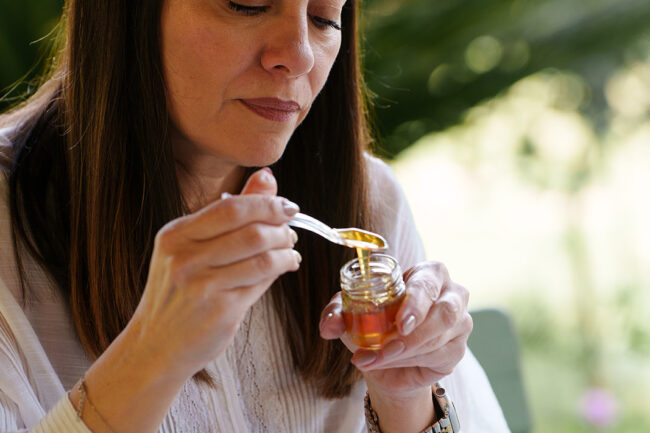
Honey Tasting workshops from Honey Experts
A Three-Pillar Solution: Stronger Laws, Modern Testing, Educated Consumers